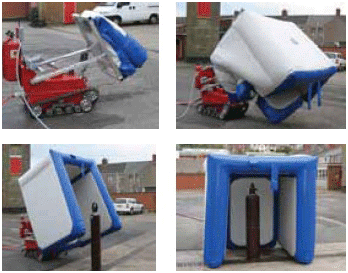
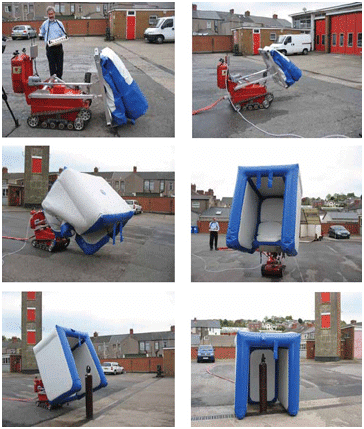
A joint venture between Cintec International Ltd and Ryland Engineering has produced a complimentary versatile combination of stand-alone fire fighting robots coupled with a blast mitigation product known as Waterwall.
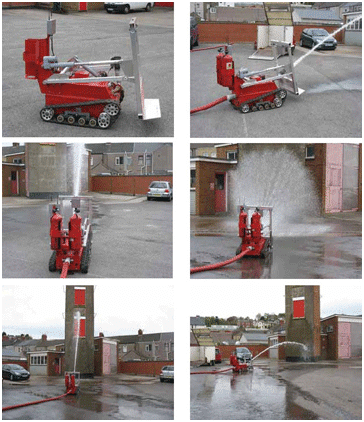
The partnership has produced a robotic vehicle that is small enough to enter narrow entrances such as domestic or small workshop doorways, climb steps and thresholds and manoeuvre around obstacles. With the aid of a camera and/or thermal imager the robot can attack the seat of the fire using an articulated arm that can be elevated and traversed remotely. The water connection is at the rear of the robot and it passes through the body of the robot into the articulated arm at the front. The arm has an electronically controlled valve attached to the end of the arm that can give a variety of spray effects to fight the fire.
Once the fire is under control, the robot is able to search the area for any dangerous acetylene gas bottles that may have been in or adjacent to the fire or any other industrial hazards. Should an acetylene bottle be discovered, the robot identifies the site and position and notes any obstacles that may obstruct clear access to the cylinder. It then returns to the controller to have a quick attachment jig mounted on the front and main body of the robot. Should it be necessary for the robot to return to the cylinder to clear an access area around the cylinder it will be able to use the jig as a plow. When a clear area has been formed, the robot returns to the controller for the Waterwall cylinder isolation unit. The Waterwall cylinder isolation unit has been tested to destruction at the Royal College of Science testing range at COTEC West Lavington, Salisbury Plain, England. This test report is available on request.
The Waterwall is attached un-inflated to the front of the robot with a water hose and air connections to the rear of the unit.
The controller guides the robot into the building and directly in front of the cylinder. Air is pumped into the isolator. The isolation unit is packed in such a way that it inflates to the correct profile and attitude that is needed to position it around the cylinder. When it forms its final shape the robot positions the unit to surround the cylinder on three sides. Usually, gas cylinders are attached to a wall or stand and an added door is not required. However, this can be provided if needed.
When the cylinder is totally encapsulated and the Waterwall is in its final position, water is pumped in displacing all the air in the bag. This is controlled using pressure relief valves positioned at the very top of the bag. When finally inflated the Waterwall surrounding the gas cylinder with 3900 litres or 1030 US gals of water reduces the stand-off safe distance to less than five metres. The robot is then remotely detached from the unit and can continue to be deployed.
This is the first inexpensive robot dedicated to positioning and placing Waterwall products over suspicious objects located in public areas. The robot can carry an un-inflated Waterwall on a portable jig through a standard door opening guided by video cameras that have day and night capability. The robot can turn in its tracks and climb a 40-degree pitch or stairway and lift via its jib a 250 kg weight a metre high. The jib can also be replaced with other appliances if another articulation is needed.
Connected to the Waterwall is a standard un-inflated water hose or standard garden hose depending on the local source that is towed behind from a hose reel under the control of an operator.
The robot also has a firefighting movable spray nozzle. Once the robot is close to the object in question, the Waterwall is inflated with air and positioned over the object. As soon as it is in position water is pumped into the Waterwall under local water pressure until the pressure relief valves are activated indicating that the Waterwall is full.
Sensors can be fitted to the internal sides of the Waterwall to monitor the anticipated threat and relay any information back to the operator.
In most cases, the suspicious object will not be an improvised explosive or dirty device and the object may be removed safely. However, should the object present a problem the situation will continue to be monitored until expert help will arrive.